41.9% of the web runs on WordPress.
But here is the trap inside this stat…
Popularity is not a quality signal. It is a snapshot of the last era, and that era is coming to an end.
BlackBerry once held roughly half the US smartphone market at its peak in 2009. And for a time, it genuinely was the best phone on the market. Right until the iPhone and Android arrived.
WordPress won the last era and deservedly so. But it's not 2010, and we are well past the peak blogging days for which it was built.
My bet is WordPress is now where BlackBerry was in 2009. On top, and about to be displaced by something built for what comes next. The difference is that a phone is easy to switch and a codebase is not, so expect no overnight collapse. Just a long, quiet erosion of market share to the CMSes built for the modern web.
I started my web dev career with WordPress and spent years building on it. I know exactly why it became the dominant CMS, and where it falls apart the moment you ask for anything bespoke. So if you are the person who has to defend a stack choice to a client or a team, this is the brief I wish someone had handed me earlier.
Three objections that still keep WordPress on the table. Let me handle them one at a time.
Objection 1: "Clients love WordPress, so that's what we build."
I get it. The brief lands, the client says WordPress, and that is where the budget is. Saying yes is the path of least resistance.
But guiding the client is part of the job.
A client knows their business. They do not know CMS architecture, and they should not have to. When a client points at the ~40% number and reads it as "best practice", they are making a technical judgment with marketing data. Pointing that out, kindly and with reasons, is what they are paying a professional for.
A doctor doesn't prescribe the most popular drug as soon as the patient walks in. They diagnose. We're supposed to weigh the tradeoffs and guide the client, even when the guidance cuts against the crowd.
Here is the part most clients never hear…
WordPress was built in 2003 as a blogging platform. Informational sites, posts, pages, comments. It is good at that. The trouble is that almost nobody hires us to build a 2003 blog anymore. They want bespoke layouts, custom content models, gated areas, and integrations.
And the moment you build something custom on WordPress, you are fighting the platform.
I felt it on every project. WordPress never settled on one modern way to build a site, so the community filled the gap with a dozen competing ones:
The classic editor
The block editor (Gutenberg)
A page builder like Elementor
Advanced Custom Fields wiring a custom backend
A headless React front end
Some other hybrid solution
Countless ways to build the site is not flexibility. It is the absence of a convention, that leads to a technical debt.
Inherit a WordPress site, and the first question is "how does this work?" That ambiguity is the cost. It slows every handover, every onboarding, every fix.
Objection 2: "There's a plugin for everything, so it's faster and cheaper."
This is the strongest argument for WordPress. Or it was….
There is a plugin for everything. Need a contact form, a slider, an SEO panel, a redirect manager. Install, activate, done.
But here is the problem…
Every plugin is code written by a third-party team, running with full access to your client's site. You are not installing a feature. You are inheriting a dependency, a security surface, and an update schedule you do not control.
Plugins are built to wildly different standards. Some are excellent. Many are not. They conflict with each other, they conflict with the theme, and a single bad update can take a site offline.
I have lost hours to exactly this. A plugin update ships, two other plugins disagree, and a site that was fine is now white-screened.
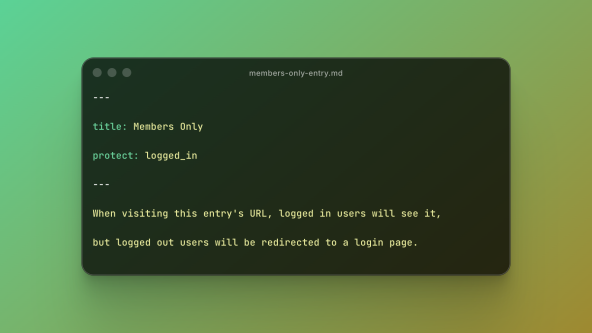
Statamic takes the opposite stance. The foundations of a modern website are baked into the core:
Forms are first-class, no plugin required.
A Replicator field lets you build your own page builder out of your own components, on your terms.
Image manipulation, caching, multi-site, revisions all ship in the box.
And here is why, in the age of agentic coding, this argument loses all its weight.
With Claude Code at my side, building a custom field or a small addon is no longer the slow, expensive part of a project. It is an afternoon.
So the old trade ("accept a stranger's plugin to save time") barely exists. I can build the exact thing the client needs, with consistent UI, own it, test it, and never wonder whether some third-party team will patch a hole before a bot finds and exploits it.
WordPress saves time today and charges you compound interest in technical debt and security risk forever.
Objection 3: "Will I even find developers to maintain Statamic?"
Fair concern. A stack nobody can maintain is a liability, no matter how elegant it is.
Here is the thing…
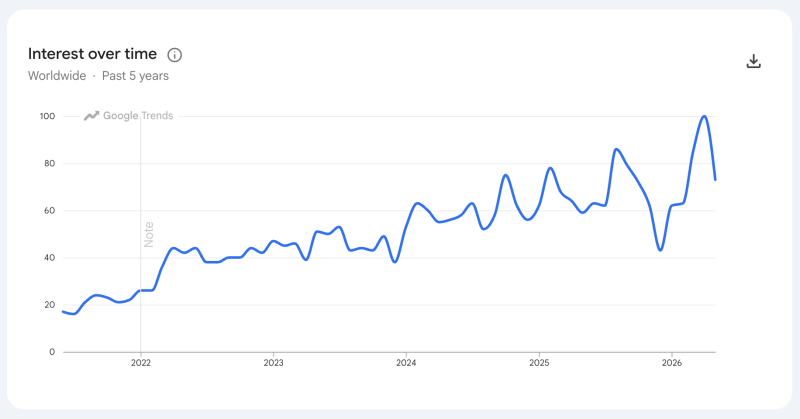
Statamic is not niche anymore. It's been steadily growing over the last 5 years.
Also, it's built on Laravel, the most popular PHP framework by a wide margin. Any competent Laravel developer picks up Statamic in days, because the conventions, project structure, the Blade templates, and the tools are all the Laravel they already know.
You are not hiring "Statamic developers." You are hiring from an enormous talent pool across Laravel and PHP.
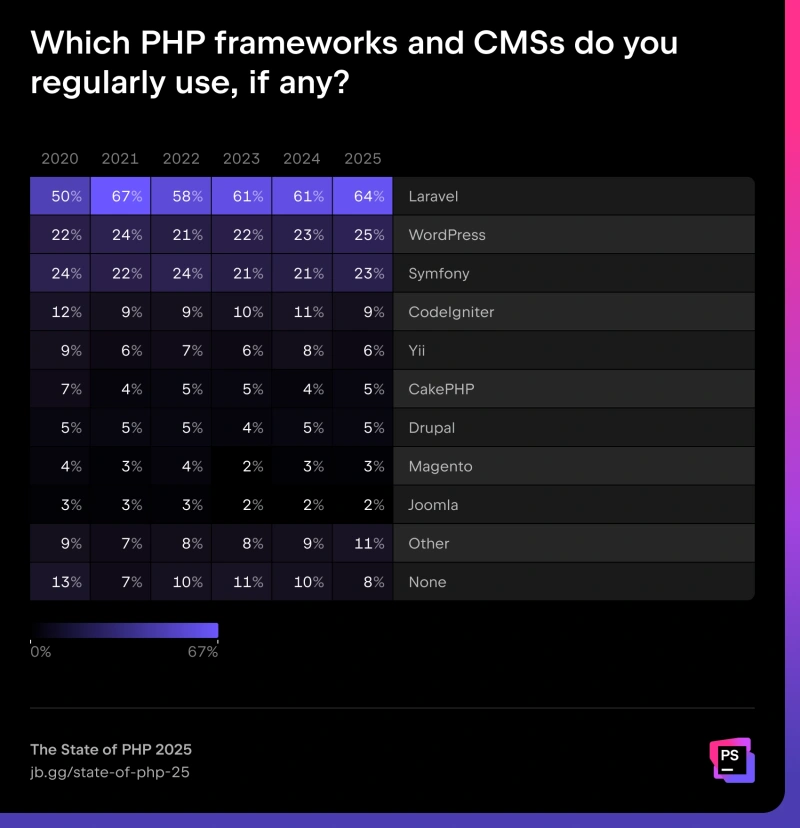
Contrast that with the WordPress reality: finding a developer is easy, but finding a really good one who writes clean, maintainable code is genuinely hard, precisely because the platform never enforced a single way to do anything.
Also, I think a lot of more ambitious devs eventually migrate away to other stacks. This is exactly what happened to me.
5 years ago, I decided to switch from WordPress to Statamic for all of my freelance work, and I couldn't be happier with this decision.
Here is why…
The architecture is faster by default
WordPress can be fast. I have made WordPress fast. It takes a caching plugin, an image optimizer, a CDN, careful query tuning, gutting the bloat it's shipped with by default, and constant vigilance against the next plugin that undoes it all. Speed is something you bolt on and defend.
Statamic is fast because of how it is built, not because of what you add to it.
There is no database query on a standard page render. Content lives in flat files, compiled natively. Statamic ships with multi-tiered caching in core, and its Static Caching compiles pages to pure HTML, which lets you serve responses in well under 100ms.
Then there is the asset problem, which is where most WordPress sites quietly lose their Core Web Vitals score. Editors upload a 4MB hero image, and the page tanks. Statamic includes Glide out of the box: automatic resizing, focal-point cropping, and WebP conversion. The unoptimized-image problem mostly disappears because the platform handles it before it reaches the visitor.
| WordPress | Statamic | |
|---|---|---|
| Default data store | MySQL database | Flat files, no DB required |
| Page speed | Optimize and defend it | Fast by architecture |
| Caching | Add a plugin | Multi-tiered, in core |
| Image optimization | Add a plugin | Glide, in core |
| Forms | Add a plugin | In core |
| Underlying framework | Ancient PHP | Laravel |
The flat-file model fixes content the way Git fixed code
Statamic content is flat files in your repository. That means content is version-controlled, exactly like code.
Anything can be copied and pasted or shared between multiple sites. The site is always backed up, and every change can be audited and deployed to the live site instantly without taking it offline.
There is no database to sync between local, staging, and production, which kills an entire category of "it works on my machine" pain.
Version control makes developers dramatically more productive with code. Flat files extend that same advantage to content.
Secure by default, not by vigilance
In 2023, Sucuri reported that WordPress was the most hacked CMS, comprising 95.5% of all detected infections. And according to Patchstack, things in the last 2 years have only gotten worse.
More high-severity vulnerabilities were discovered in the WordPress ecosystem in 2025 than in the previous two years combined.
No doubt that vibe coding is leaving its mark. WordPress already had the lowest barrier to shipping a plugin. Now, anyone can have an LLM generate one they cannot read, let alone secure, and push it to thousands of sites.
Combine that with the fact that attackers now wield AI that is increasingly capable of autonomously finding and exploiting security vulnerabilities, and you get a security nightmare that will only continue to get worse in 2026/27.
I see it myself in my server logs. Bots crawl my Statamic sites, probing for wp-config.php, wp-login.php, and xmlrpc.php. Files that do not exist. The bots do not care what you run. They assume WordPress because the odds say WordPress.
File probing is just the noisy half. A large share of these automated attacks go after the database through SQL injection. But Statamic uses no database out of the box. No database, no SQL injection surface. You can enable a database when a project genuinely needs one, but the default removes a whole class of automated attacks before you write a line of code.
Smaller surface, fewer doors
No third-party plugin soup and no database by default means there are simply fewer ways in. Security is not a feature you add. It is a consequence of what you did not install.
The editing experience your clients actually enjoy
WordPress editing has fractured across the classic editor, Gutenberg, and whatever page builder the last agency bolted on. The experience a content editor gets depends entirely on how the site was assembled.
Statamic gives editors one consistent, predictable control panel. Fields are fields. The page builder is one Replicator field built from the exact blocks I defined, and it looks the same on every site I ship.
Compare that to inheriting a WordPress site where the hero is an Elementor widget, the body is Gutenberg, and the sidebar is a shortcode from a plugin three versions out of date.
I spend far less time explaining Statamic to editors, because mostly it's intuitive. As good design should be.
But don't take my word for it, check out this demo of the Statamic control panel.
When the project outgrows a CMS, you don't switch stacks
This is where Statamic shines.
Because Statamic is Laravel, the full framework is right there when a project outgrows a content site.
A good example is a membership platform. Serve the public marketing and content pages with Statamic, then reach into Laravel for the gated members area, billing, and dashboards. One application, one codebase, one deploy.
And there is another reason that matters more every month: consistency is what makes AI coding agents reliable.
Every Statamic site follows similar structures and patterns, on top of Laravel's decade-plus of stable, opinionated conventions. That predictability is exactly what an LLM needs to generate maintainable code that fits, instead of guessing from expertise it doesn't have.
The community you would actually want to be part of
Statamic is part of a wider Laravel community. It's one of the largest and most genuinely welcoming developer communities I've worked in. People ship, share, and help.
Contrast that with the public drama and founder toxicity that's followed WordPress lately. The platform you build on is also the people you build alongside. I'd rather stand on a stack run by a team I respect, surrounded by a community that wants everyone to do good work.
So what do you tell the client
Lead with the trade-off, not the trend.
WordPress is the safe-sounding default that quietly costs you on every custom build: plugin conflicts, a permanent security target, performance you have to defend, and countless different ways to build.
Statamic gives you version-controlled content, speed by architecture, a smaller attack surface, a consistent editor experience, and the entire Laravel ecosystem behind it when the project grows.
So the next time a client reads popularity as proof, do not argue with the number. Build them the thing that makes the number irrelevant.